The bogobox booster
Table of Contents
What is the bogobox?
The bogobox is my selfmade transformer-booster combination, which I
use for my märklin digital layout together with
DDL, the software-based digital
control unit. The principles of digital control units and software-based units
are described in the next two chapters, for those readers who are interested.
The bogobox, as a booster, takes the digital signal to provide power to the
tracks, or a section of tracks. The features of the bogobox are:
- transformer built into the booster to avoid additional wiring
- transformer with two secondary windings for optimum electrical performance, i. e. minimized
voltage ripple thanks to full wave rectification
- generous filter capacitors to reduce voltage ripple and voltage drop under high load
- symmetric bipolar output driver stage in common emitter configuration for high efficiency with
minimum heat dissipation
- protection through current limitation and automatic turn-off after short
circuit
- output signal is off if input signal is not present to avoid unintended autonomous operation.
- external push button inputs to turn on and off the booster, i. e. an "emergency stop button"
- serial computer interface via optocouplers
- feedback of operational state via serial computer interface
The bogobox can be used in the following configurations
- booster to a computer/software-based control unit, like
DDL or
DDW.
- booster for any digital control unit that generates a bipolar voltage signal,
e. g. Märklin 6021, Märklin Delta Controls, Intellibox, etc.
- since the booster produces a zero output for a zero volt input, it might even be suitable
for three-level digital signals, like selectrix or FMZ.
However, I am not familiar at all with these
systems, so you may go ahead at your own risk and knowledge.
Feedback is welcome.
- the booster does not support any bidirectional communication such as Märklin mfx or DCC
CV reading or Railcom communication
Important Notes and Warnings
A serious word of warning: Only consider the information provided here as
a documentation of my work, not as instructions how to build such a booster
yourself. The circuit is
connected to the mains which has lethal voltage levels! If you have decided to
build such a booster yourself, you are fully responsible to comply with the
applicable rules and regulations concerning electrical safety and radio
interference. I strongly recommend to seek professional advice.
According to German VDE regulation, and equivalent European Norms, electric
toys (including model railways) must be operated on so-called "safety extra low voltage"
(SELV). AC voltage must be below 24 V. Hence, the later proposed
operation of the booster from two 16 V transformers of opposite phase is,
strictly speaking, not allowed, since the voltage between two poles can have 32
V AC. I therefore suggest to build transformer and booster into one closed
case.
To produce SELV, only safety
transformers complying with VDE 0551 are allowed. Such transformers
separate the SELV from the line voltage by double insulation.
The voltage-carrying parts
of the SELV circuit must not have connection to protective ground or earth
potential. Several SELV circits may only be connected if SELV voltage
limits are not exceeded. This has a severe consequence if the booster shall be
used together with a computer acting as central unit (e.g. running DDL, or
DDW). The computer runs with "protective extra low voltage" (PELV) which is
connected to protective ground from the power line. Connection with SELV is not
allowed and therefore optocouplers must be used for operation with a
computer.
Due to its importance, the same again in Deutsch
Diese Seite als Dokumentation meiner Arbeit zu verstehen, nicht als
Anleitung zum Nachbau eines Boosters. Das Gerät ist mit Netzspannung (230 V) verbunden, es treten
also tödliche Spannungen auf! Wenn sie so einen Booster bauen, sind sie voll
dafür verantwortlich, alle Regeln und Normen bezüglich elektrischer Sicherheit
und Störstrahlung einzuhalten! Wenden sie sich bitte an eine Fachkraft.
Gemäß VDE und entsprechenden Europäischen Normen darf elektromotorisches
Spielzeug nur an Anlagen mit max. 24 V Schutzkleinspannung (safety extra low
voltage, SELV) angeschlossen werden. Der nachstehend empfohlene Betrieb des
Boosters mit zwei 16-V-Transformatoren, deren Ausgangsspannung gegenphasig ist,
entspricht damit nicht dieser Forderung, da zwischen zwei Leitungen eine
Spannung von 32 V auftreten kann. Ich empfehle daher, Transformator und Booster
in ein gemeinsames geschlossenes Gehäuse einzubauen.
Zur Erzeugung von Schutzkleinspannung sind nur Sicherheitstransformatoren
nach VDE 0551 zulässig. Solche Transformatoren trennen die Schutzkleinspannung
von der berührungsgefährlichen Niederspannung durch eine doppelte Isolierung.
Dies geschieht z. B. mittels einer Zwei-Kammer-Wicklung.
Die aktiven, d. h. spannungsführenden Teile des
Schutzkleinspannungs-Stromkreises dürfen weder mit Erde noch mit aktiven Teilen
anderer Stromkreise verbunden werden. Schutzkleinspannungs-Stromkreise dürfen
untereinander nur dann verbunden werden, wenn dadurch die oben genannten
Spannungsgrenzen nicht überschritten werden. Dies hat Konsequenzen, wenn der
Booster an einem Computer betrieben werden soll, wo der Computer die Rolle der
Zentraleinheit übernimmt (z. B. mit Software wie DDL oder DDW). Der Computer
wird mit Funktionskleinspannung (protective extra low voltage, PELV) betrieben
und ist mit dem Schutzleiter der Netzzuleitung verbunden. Eine Verbindung mit
der Schutzkleinspannung der Modelleisenbahn ist nicht zulässig. Es müssen daher
Optokoppler beim Betrieb mit Computer verwendet werden.
The bogobox schematic
Here is a schematic of my bogobox booster:
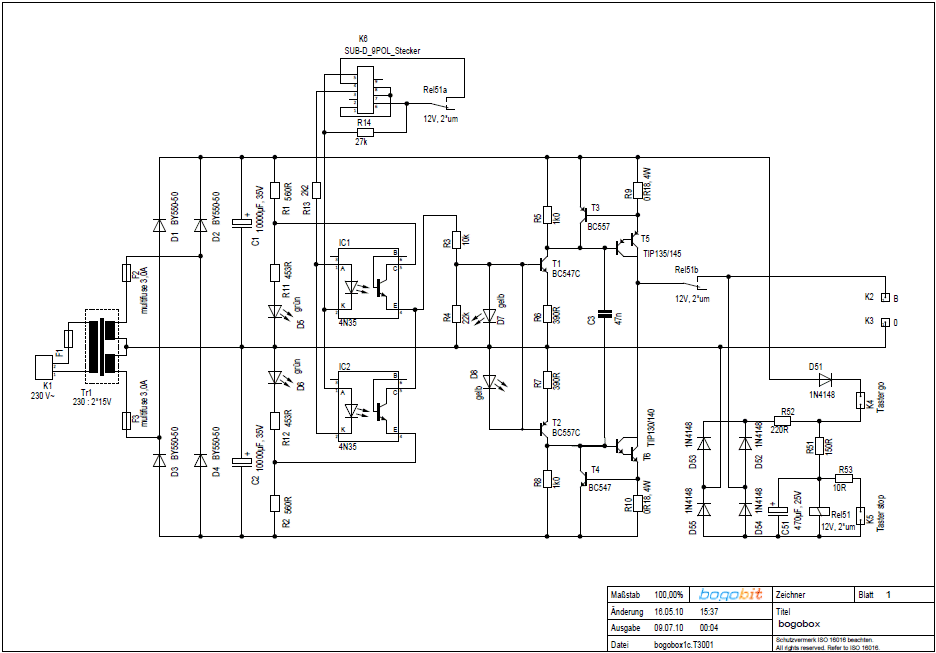
The schematic is also available as PDF-File.
Some notes on the schematic:
- Connector K1 goes to the primary side of the transformer.
F1 is a melting fuse (rated at approximately double the nominal
transformer primary current, medium to slow characteristic).
I use a transformer with two secondary windings. This has the
advantage that
both positive DC voltage (at C1's positive side) and negative DC voltage
(at C2's negative side) can be rectified in full wave
rectifier bridges (D1-D4) which reduces the voltage ripple.
-
The transformer secondaries are protected by semiconductor PTC fuses, F2, F3, known
also under the brand "multifuse", or "polyswitch".
-
The booster output current is limited to prevent any immediate damage
to the output driving transistors, T5, T6,
and other components due to overcurrents.
The output current is sensed by resistors R9, R10. If their voltage
drop exceeds approximately 0.7 V, T3 or T4 become conductive and cut off the
driving transistor's base current.
-
The booster output could directly be taken from the collectors of T5 and T6,
but here it is switched by a relay Rel51. Once the relay
has been activated manually by a push botton switch connected to K4,
it holds itself from the booster's own voltage
output. But if the voltage drops (due to high load and
current limiting operation) or collapses completely (caused either by a
short circuit on the rails, or by a missing voltage input from the
computer) the relay switches off. The relay is activated by a manually
operated push button switch connected to K4. The relay can be manually
deactivated by push button "emergency" switch connected to K5.
All components of the undervoltage turn-off part have
reference numbers of 50 and above.
- Expected voltage drop at maximum current:
Assume that we draw a constant DC current of Imax = 3.0 A from
the output, the filter capacitor (C1 or C2 in the schematic) shall have a
capacity of C = 10000 uF. We use full-wave rectification. The resulting
voltage ripple then is dU = Imax * dT / C = 3.0 A * 10 ms / 10000 uF = 3.0 V.
This means, the voltage of C1 or C2 drops by 3.0 V until it is recharged.
- Maximum output current:
The maximum output current is set with the sensing resistors R9 and R10.
Choose R = 0.6 V / Imax = 0.6 V / 3.0 A = 0.20 Ohm, which has been rounded
down to 0.18 Ohm. The resistor must withstand a power of P = 0.6 V * Imax =
0.6 V * 3.0 A = 1.8 W.
- In usual operation, the voltage drop across T5 and T6 is less than 2 V. At 3
A output current this makes 2 V * 3 A = 6 W heat dissipation, which seems not
be critical at all. However, at a short circuit situation still 3 A output
current flow, but the full voltage is applied across T5 and T6.
At a short a transistor produces heat of
approximately 15 V * 3 A = 45 W !
- Thermal design of T5 and T6:
Let us assume that the undervoltage turn-off is set at 5 V below the
usual output level. Then the voltage drop across T5 and T6 may be up to 7 V instead of
the usual 2 V. With 3 A of current this makes 7 V * 3 A = 21 W of heat.
Therefore we need a thermal resistance of our total cooling means of
Rthermal = 125 K / 21 W = 5.95 K / W;
The transistor's thermal resistance is 1.78 K / W, so the heatsink must
have thermal resistance of 5.95 - 1.78 = 4.17 K / W or less.
- In an overload or short circuit condition, the current limitation is in
effect. Then the output voltage drops and the voltage across T5 and T6 rises.
To avoid thermal damage under overload conditions, which are characterised
by a decreasing output voltage, the output voltage collapse is sensed and
the output is switched off by a relais contact. The undervoltage threshold
is set with R52 and depends also on the relais's winding resistance. With
a greater R52 the threshold rises (because the voltage at the relais reduces).
- If the bogobox should be used as a booster to digital command station
(like märklin's 6020 or 6021,
märklin's delta control 6604, 66045, 6607, the
Intellibox, or something equivalent) but not to a PC, the optocouplers IC1 and IC2
are not required, and the input signal (track output signal of the command
station) is connected to (the optocoupler's end of) R3.
- Feedback of operational state to PC:
The operational state (that is the state of Relais Rel51) is signaled to the PC on
the DSR status line of the serial port.
The DSR line state is switched by a contact of the relais.
In the normal operational state, the DSR line is connected with the DTR line.
If the PC sets DTR to high, the DSR = high means normal operation.
In the power off state, the DSR line is tied to GND via R14.
Although strictly speaking, GND is not a valid voltage for RS232, a PC's
serial port usually interpretes this reliably as a DSR = low.
How to use
When the bogobox is initially powered on, the "GO" button at K4 has to be pressed
to activate
the relay contact and power the rails. If there is no voltage on the serial
input which is the case when the computer is off or not connected, no output
voltage will be produced and the relay cannot hold itself activated.
In an emergency, the "STOP" button at K5 has to be pressed
to de activate the relay contact and disconnect power from the rails.
The PC must output the digital signal on the TxD line of the serial port.
The PC may detect the operational state of the bogobox booster from the
DSR line of the serial port.
External connections
Connections at the rear of
the box comprise
- a power cord to the mains (from schematic K1)
- a red and brown plug to the track (K2 and K3)
- a 9 pin D-Sub male connector, to be connected to a PC by a 1:1 cable (K6)
- two green plugs to a normally open momentary switch (K4)
for a "GO" button
- two red plugs to a normally open momentary switch (K5)
for a "STOP" button

